Banská Bystrica, Slovakia

The region in southern Slovakia is building climate resilience through sustainable land and water management.
Banska Bystrica

Image from Pexels by Manuel Campagnoli

Key Numbers

614 000

Inhabitants

2.7°C

Increase in average temperatures over 55 years

84%

Of forests are primarily used economically

The region spans nearly 9,500 km², encompassing 514 municipalities and about 614,000 inhabitants. Twelve of these municipalities, including Ábelová, make up the Novohrad Suburbium (Novohradské Podzámčie, which translates as the New Castle Borough), a historical microregion that enhances community and infrastructure. 

Ábelová’s population has declined to 208 residents - an 84% decrease over the past five decades - reflecting broader rural depopulation across Central and Eastern Europe following socialist-era land nationalization and the collapse of traditional agriculture. Despite this drastic reduction, the community remains lively and engaged, with over half of its population in the productive workforce (57%), unemployment down to 10 % (from 30% in recent years), and 25% of its residents being children, offering hope for the future.

Economically, Ábelová relies on agriculture, forestry, and a growing eco-tourism sector. Forests cover over 40% of the area, while about half of the land is used for agricultural purposes, such as farming and grazing. The forests are primarily designated for economic use (84%), while 16% are conserved. The main landholder, AB Laz s.r.o., manages roughly 58% of the territory (1,800 ha of farmland and 1,200 ha of forest) and is the largest regional employer.

In the SystR project, Ábelová serves as a model site for building climate resilience through sustainable land and water management. The initiative promotes nature-based solutions to restore local water cycles, enhance soil health, and increase resilience to drought and heat. Key goals include improving soil water retention and fertility, strengthening carbon sequestration, and reducing dependence on industrial fertilizers. Rainwater harvesting and soil rehydration help create healthy “soil sponges” that retain water and nutrients while limiting erosion.

The project also monitors the economic and ecological impacts of these interventions to inform future policies under the Common Agricultural Policy (CAP), forest management, and spatial planning. By testing models for sustainable land and water use across forestry, agroforestry, and infrastructure, Ábelová and the Novohrad region contribute to a more resilient and self-sustaining Ipel (Ipoly) River basin shared with Hungary.
Drought is the most persistent challenge, driven by long dry periods and irregular rainfall. Rain increasingly falls in short, intense bursts, followed by extended dry spells that deplete soil moisture and, in turn, reduce yields. Water scarcity is intensified as much of the rainfall quickly runs off rather than infiltrating the soil, highlighting the need to retain more rainwater through small reservoirs, infiltration measures, and improved soil management. Historically, the village of Ábelová struggled with insufficient groundwater, which exacerbated fire risks in wooden houses with thatched roofs as early as the 18th century.

Rising temperatures have further intensified stress on crops and livestock. Since the late 1970s, average annual temperatures in Ábelová have steadily increased, bringing hotter summers and milder winters. The increase in average annual temperatures also raises evaporation demands by an estimated 270 mm per year. 

In this context, spring frosts have become another major risk for the agricultural sector. After warm early spring periods, sudden cold snaps severely damage fruit trees and vineyards. In 2023, for instance, orchard crop yields fell by around 50% compared to the previous year due to frost losses.

Together, these hazards make farming increasingly unpredictable and vulnerable, underscoring the urgent need for local adaptation to safeguard Ábelová’s agricultural productivity and community resilience.

The project activities in Ábelová will be led by the People and Water NGO, which will provide hydrological analysis and modeling, as well as technical support. Developed in cooperation with the Forestry Union (Únia lesov), the demonstration activities will take place within the village, on nearby farms, and in surrounding agricultural and forest areas, serving as practical models that can be replicated throughout the Novohradské Podzámčie (Novohrad Suburbium) microregion.

A range of measures will be tested to retain rainwater, reduce runoff, and enhance soil moisture. These include bioclimatic gardens to collect and filter stormwater in built-up areas, infiltration pits and contour terraces to increase groundwater recharge, and green roofs and walls that capture rainwater while cooling local environments. In the agricultural and forest landscape, small water reservoirs and wetlands will be established to store water, support biodiversity, and provide fire protection. Wooden check dams and infiltration dimples along unpaved roads will further slow runoff and reduce erosion. Initial estimates by People and Water show that Ábelová has the capacity to harvest around 174,000 m³ of rainwater - equivalent to 70 Olympic-sized swimming pools, or about 75 FIFA-regulated soccer fields knee-deep in water.

Beyond field implementation, the project will develop a Climate Resilience Action Plan for the 22,000-hectare Novohradské Podzámčie microregion, covering 12 municipalities. This plan will integrate the tested NBS into broader strategies for sustainable land, water, and forest management. By linking practical demonstrations with regional planning, the Ábelová site aims to offer replicable models for improving rural climate resilience in the Banská Bystrica region and across similar European landscapes. 

Connected Partners

People and Water logo
Abelova logo
SUA Logo
UNIA logo

Timeline

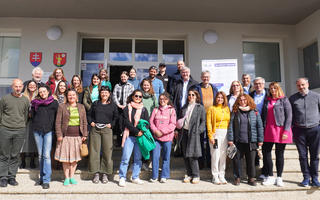
SystR partners in Ábelová (Slovakia)

In April 2026, partners from across Europe came together in the Slovak village of Ábelová for the third consortium meeting of the SystR project.

Read more

A photo of a poster being worked upon, making connections between different risks

#Guidelines, #Project Deliverable

The Regional Adaptation Board (RAB) Booklet is developed as a roadmap to establishing a Regional Adaptation Board  - and related Climate Innovation Hub (...

Read more

This is recommended related external content and can be viewed by clicking on it. By clicking you consent to the display of external content. This enables personal data to be transmitted to third-party platforms.

Read more about our privacy policy.

#Video

SystR's work in and around Ábelová (Slovakia) was recently featured on the STVR :24 news channel!

Read more